
Gutter guards have been marketed as the solution that makes gutter maintenance a thing of the past. The pitch is appealing: install them once and stop worrying about leaves and debris blocking your gutters. A lot of homeowners in Arlington have gone that route, and a lot of them have still ended up with clogged gutters a few years later wondering what went wrong. The reality of how gutters perform in North Texas is a bit more complicated than any single product can fully address.
How Gutters Get Clogged in Arlington
Arlington sits in a part of Texas where the tree cover is significant. Oak trees are everywhere in the area, and they drop not just leaves but also small catkins, pollen, and seed debris throughout the year. That kind of fine material behaves differently from large leaves, and it is the thing that gives a lot of gutter guard systems trouble.
Large leaves are actually the easier problem. They sit on top of surfaces, dry out, and can be blown off or rinsed away without much effort. Fine debris like seed pods, oak catkins, and pollen accumulate on screens and mesh over time and eventually create a layer of compacted material that water cannot pass through easily.
The Rain Patterns Make It Worse
North Texas gets a decent amount of rainfall, but it tends to come in bursts rather than steady light rain. A heavy downpour drops a large volume of water onto the roof quickly, and that water needs to move through the gutters fast. When debris has built up on a gutter guard screen, water may overshoot the gutter entirely during a heavy rain rather than being channeled into it. That means water running down the side of the house and pooling at the foundation, which is exactly what gutters are supposed to prevent.
What Gutter Guards Actually Do Well
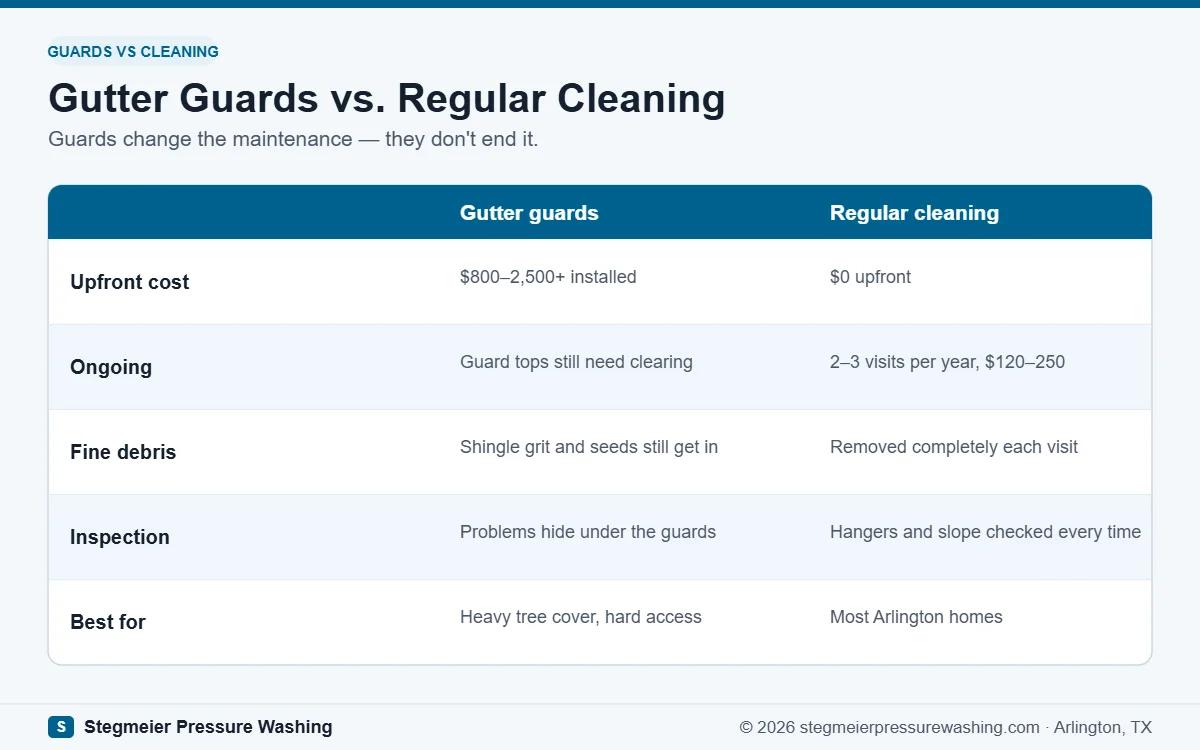
It is not that gutter guards have no value. They do reduce the frequency of certain types of clogs, particularly large debris clogs in areas with heavy leaf fall. A home surrounded by trees that drop large leaves will see fewer full blockages with guards installed than without them.
Guards also help reduce the amount of standing water and organic material that sits in gutters between cleanings, which slows down the deterioration of the gutter material and reduces mosquito breeding habitat. For homeowners who find it difficult to schedule regular maintenance, having some level of protection is better than none.
The Trade-Off With Guards
The issue is that gutter guards create a false sense of security. Many homeowners install them and assume the problem is solved. They stop checking the gutters and stop scheduling cleanings. Over time, the fine debris builds up on top of the guards, and the gutter system starts performing poorly even though it looks fine from the ground.
Some gutter guard systems also make it harder to access the interior of the gutter when a cleaning does become necessary. Removing and reinstalling guards adds time and cost to the job, and some guard types are not designed to be easily removed at all.
Regular Gutter Cleaning as the Baseline
Regular gutter cleaning, done at least twice a year, is the baseline that keeps a gutter system functioning the way it is supposed to. In Arlington, most professionals recommend cleaning in the spring after peak pollen and catkin season, and again in the fall after the majority of leaf drop is finished.
A proper cleaning removes debris from inside the gutter channel, clears the downspouts, and flushes the system with water to confirm it is draining correctly. That last step matters because a downspout can be partially blocked in a way that is not obvious until water is run through it.
Inspecting While Cleaning
One of the practical benefits of regular professional cleaning is that the person doing the work gets eyes on the gutter system up close. Gutters develop small issues over time: sections pull away from the fascia, joints start to separate, downspout elbows crack. Catching those problems early is much less expensive than dealing with the water damage that follows when they go unnoticed.
A gutter guard, while it may reduce debris inside the gutter, does not give anyone a reason to get up on a ladder and look at how the system is doing overall. Regular cleaning builds that inspection into the maintenance schedule automatically.
The Case for Combining Both
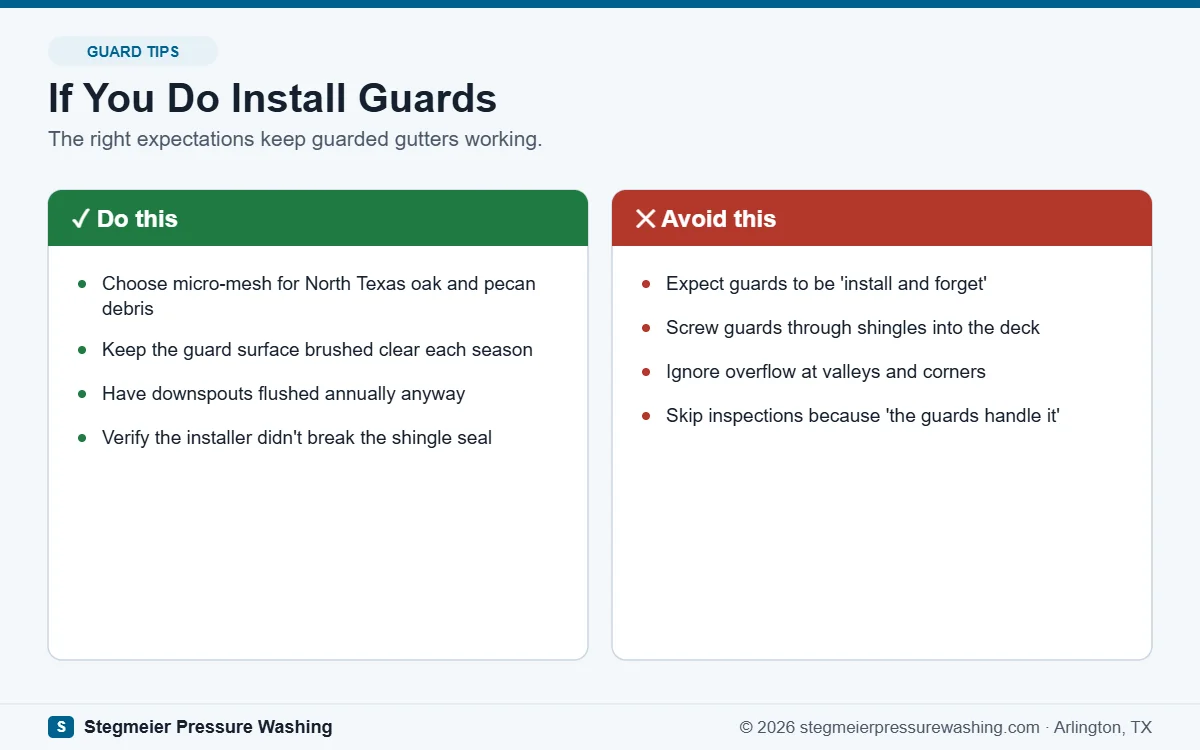
Some homeowners do well with a combination approach. A micro-mesh guard with a fine enough screen to block most debris, combined with an annual cleaning to remove the fine material that accumulates on the surface of the screen, can work reasonably well in Arlington’s environment.
The key is not assuming that the guard replaces the cleaning. It may reduce how often cleaning is needed or how much debris ends up inside the gutter, but the maintenance requirement does not go away entirely.
What to Prioritize in Arlington
For most homes in the Arlington area, the practical answer is to put the investment into regular professional cleaning rather than spending heavily on a guard system that may still require maintenance. Two thorough cleanings per year, done at the right times of year, keep gutters functioning and give the homeowner visibility into the condition of the system.
If guards are already installed, keeping up with cleaning remains important. The guards do not eliminate the need for maintenance; they just change what the maintenance looks like.
If you plan to clean gutters yourself, review Portable Ladder Safety from OSHA.
The Bottom Line on Gutter Maintenance
Gutters are not glamorous, but they do important work. Water damage from failed gutters shows up at foundations, in basements, along fascia boards, and in landscaping beds. The cost of that damage is substantially higher than the cost of staying on top of cleaning.
Gutter guards can be a useful tool, but they work best when homeowners understand what they do and do not do. In a city like Arlington, where fine debris and heavy rain events both put pressure on gutter systems throughout the year, regular cleaning is the part of the equation that cannot be skipped.
Related: How much gutter cleaning costs in DFW
Gutters overflowing? Our gutter cleaning service in Arlington, TX removes debris by hand, flushes downspouts, and cleans up afterward. Book a free estimate or try our pressure washing cost calculator.