Pressure washers are often marketed using big PSI numbers, leading many buyers to believe pressure alone determines cleaning power. In reality, understanding the balance between PSI and GPM is what helps you choose the right machine for safe, efficient, and fast cleaning. Whether you are washing vehicles, cleaning patios, restoring concrete, or handling commercial pressure washing projects, both ratings matter.
This complete guide explains how PSI vs GPM pressure washer performance works, why both measurements are important, and how to choose the ideal combination for your cleaning needs.
Short Answer — PSI vs GPM Pressure Washer
PSI (Pounds per Square Inch) measures the pressure force of a pressure washer, while GPM (Gallons Per Minute) measures the amount of water flow. PSI determines how strongly water hits a surface, whereas GPM determines how quickly dirt and debris are rinsed away. The best pressure washer balances both PSI and GPM for efficient cleaning performance.
What Does PSI Mean in a Pressure Washer?
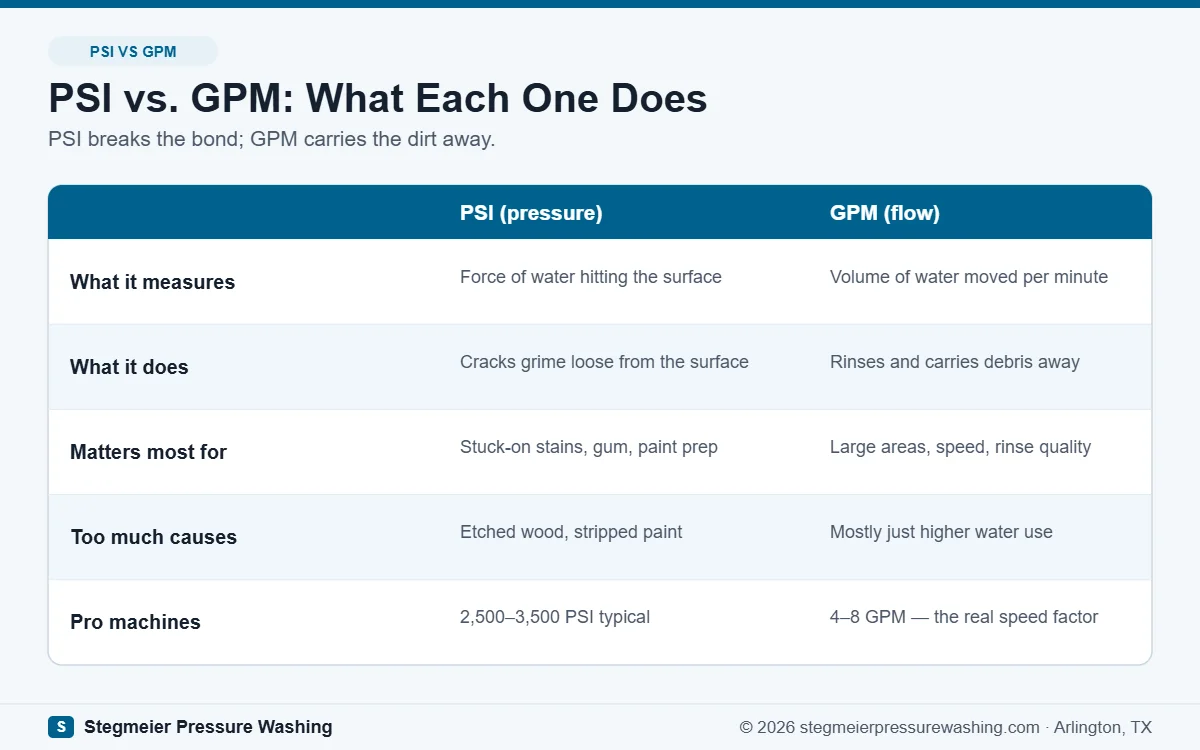
Understanding PSI (Pounds per Square Inch)
PSI measures the force of water coming out of the pressure washer nozzle. Higher PSI creates stronger impact against surfaces and helps break apart stubborn dirt, grease, grime, mold, and stains.
A higher PSI rating means:
- Stronger cleaning force
- More aggressive surface penetration
- Better deep-cleaning capability
- Faster removal of stuck debris
Pressure becomes especially important for hard surfaces such as:
- Concrete driveways
- Brick walls
- Garage floors
- Stone patios
- Industrial equipment
Why PSI Matters for Cleaning
PSI directly affects how aggressively the machine cleans. Tough stains often require higher pressure to loosen dirt effectively.
Benefits of higher PSI include:
- Better grease removal
- Paint stripping ability
- Mold and algae cleaning
- Deep concrete cleaning
- Faster stain removal
However, excessive PSI can damage delicate surfaces like wood siding, vehicle paint, vinyl, and soft decking.
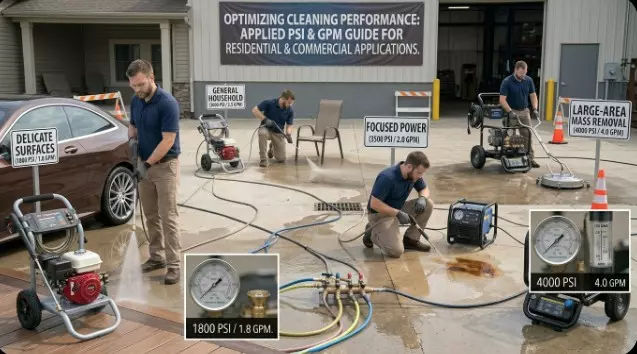
Common PSI Ratings by Usage
| Cleaning Task | Recommended PSI |
|---|---|
| Cars & patio furniture | 1,300–2,000 PSI |
| Decks & fences | 2,000–3,000 PSI |
| Driveways & concrete | 3,000+ PSI |
| Commercial cleaning | 3,500+ PSI |
What Does GPM Mean in a Pressure Washer?
Understanding GPM (Gallons Per Minute)
GPM measures how much water flows through the machine every minute. While PSI breaks dirt loose, GPM determines how quickly debris gets rinsed away.
Higher GPM means:
- Faster cleaning
- Better rinsing performance
- Wider cleaning coverage
- Reduced cleaning time
Why GPM Matters More Than Many Buyers Realize
Many homeowners focus only on PSI because manufacturers advertise large pressure numbers. However, experienced contractors understand that higher GPM often improves real-world productivity more than extreme PSI.
Benefits of higher GPM include:
- Faster driveway cleaning
- Better mud removal
- Improved detergent rinsing
- More efficient commercial work
- Less streaking on surfaces
Typical GPM Ratings
| Usage Type | Typical GPM |
|---|---|
| Light residential cleaning | 1.2–2.0 GPM |
| Medium household work | 2.0–3.0 GPM |
| Commercial pressure washing | 3.5+ GPM |
PSI vs GPM Pressure Washer — Main Differences
Pressure vs Water Flow
The biggest difference between PSI vs GPM pressure washer ratings is simple:
- PSI controls cleaning force
- GPM controls cleaning speed
A machine with extremely high PSI but low GPM may hit hard but clean slowly. Meanwhile, high GPM with low PSI may rinse quickly but struggle with stubborn grime.
Which Matters More for Cleaning?
In most real-world cleaning situations, balance matters more than one extreme specification.
- High PSI helps cut through grime
- High GPM speeds up washing
- Balanced systems clean most efficiently
Professional contractors often prioritize GPM because productivity matters during large-scale jobs.
Cleaning Speed Comparison
Higher GPM usually means faster cleaning times because more water removes loosened dirt quickly.
Excessive PSI without adequate water flow can:
- Leave streaks
- Slow down rinsing
- Damage surfaces
- Reduce efficiency
Impact on Surface Types
Different surfaces require different PSI and GPM combinations.
| Surface Type | Best Priority |
|---|---|
| Concrete | Higher PSI |
| Vehicles | Moderate PSI + balanced GPM |
| Wood decks | Moderate PSI |
| Large commercial areas | Higher GPM |
How PSI and GPM Work Together
Understanding Cleaning Units (CU)
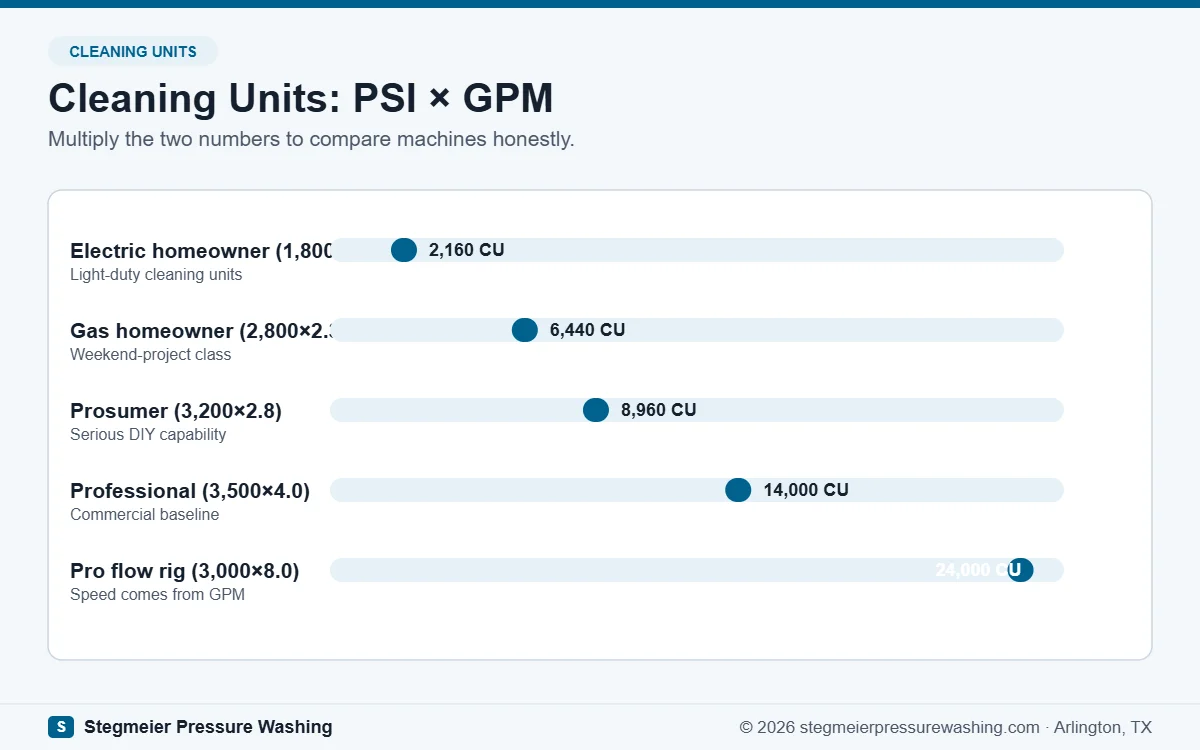
Professional cleaners often evaluate pressure washers using Cleaning Units (CU):
CU=PSI×GPMCU = PSI \times GPMCU=PSI×GPM
This formula shows how pressure and water flow combine to determine total cleaning performance.
Why Balanced Output Matters
Examples:
- 4,000 PSI with 1.5 GPM may clean aggressively but slowly
- 2,500 PSI with 4 GPM may clean faster overall
Balanced machines often outperform extreme-pressure units in real-world residential cleaning.
Example of PSI and GPM Balance
| PSI | GPM | Best Use |
|---|---|---|
| 2,000 | 1.5 | Car washing |
| 3,000 | 2.5 | Residential cleaning |
| 4,000 | 4.0 | Commercial jobs |
How to Choose Between PSI vs GPM Pressure Washer
Step 1 — Identify What You Need to Clean
Different surfaces require different cleaning power.
- Cars need lower PSI
- Concrete requires higher PSI
- Large surfaces benefit from higher GPM
Step 2 — Consider Surface Sensitivity
Using excessive pressure can damage surfaces.
Avoid high PSI on:
- Painted siding
- Soft wood
- Vehicle paint
- Windows
Use adjustable nozzles whenever possible.
Step 3 — Determine Cleaning Frequency
Occasional users usually need smaller residential units.
Frequent users or professionals benefit from:
- Higher GPM
- Commercial pumps
- Better durability
- Continuous-duty systems
Step 4 — Compare Residential vs Commercial Needs
Residential users often prioritize:
- Lower cost
- Easy storage
- Simpler operation
Commercial users prioritize:
- Speed
- Reliability
- Long operating hours
- Faster productivity
Step 5 — Choose Balanced PSI and GPM Ratings
Avoid choosing solely based on marketing numbers. Practical cleaning performance matters more than maximum PSI.
PSI vs GPM Pressure Washer
| Feature | PSI | GPM |
|---|---|---|
| Full Meaning | Pounds per Square Inch | Gallons Per Minute |
| Measures | Water pressure force | Water flow volume |
| Main Function | Breaks dirt loose | Washes debris away |
| Higher Rating Benefit | More cutting power | Faster cleaning |
| Best For | Tough stains | Large surfaces |
| Risk if Too High | Surface damage | Excess water usage |
| Important For | Deep cleaning | Cleaning efficiency |
Best PSI and GPM Ratings for Different Cleaning Tasks
Car Washing
Recommended:
- 1,200–1,900 PSI
- 1.4–2.0 GPM
This combination protects paint while providing effective cleaning.
Deck and Fence Cleaning
Recommended:
- 2,000–2,800 PSI
- 2.0–2.5 GPM
Moderate pressure helps avoid wood damage.
Concrete and Driveways
Recommended:
- 3,000+ PSI
- 2.5–4.0 GPM
High pressure removes oil stains and embedded grime effectively.
Commercial Pressure Washing
Professional setups often use:
- 3,500+ PSI
- 4+ GPM
Companies handling large-scale cleaning projects rely heavily on higher GPM for productivity.
Common Mistakes When Comparing PSI vs GPM Pressure Washer
Focusing Only on PSI
Many buyers assume higher PSI automatically means better cleaning. In reality, low GPM can reduce overall performance significantly.
Ignoring Surface Safety
Too much pressure damages:
- Wood
- Paint
- Vinyl siding
- Delicate finishes
Buying Undersized Equipment
Low GPM systems may struggle during heavy-duty cleaning tasks.
Choosing Commercial Units for Small Tasks
Oversized machines can:
- Increase fuel usage
- Raise maintenance costs
- Make operation harder unnecessarily
Sub-Questions People Also Ask About PSI vs GPM Pressure Washer
Is PSI or GPM more important in a pressure washer?
Both matter equally. PSI breaks dirt loose while GPM rinses debris away.
What PSI is safe for washing cars?
Most vehicles clean safely between 1,200 and 1,900 PSI.
Does higher GPM clean faster?
Yes. Higher GPM increases rinsing efficiency and speeds cleaning significantly.
Can too much PSI damage concrete?
Yes. Excessive pressure can etch concrete surfaces over time.
What is a good PSI and GPM combination?
For most homeowners, 2,500–3,000 PSI with 2.3–2.8 GPM works well.
Why do commercial pressure washers use higher GPM?
Higher GPM improves cleaning speed and productivity during large jobs.
Is 2.5 GPM enough for driveway cleaning?
Yes. Combined with adequate PSI, 2.5 GPM handles most residential driveways effectively.
What pressure washer size do professionals use?
Commercial contractors commonly use 3,500–4,000+ PSI with 4+ GPM.
Maintenance Tips for High-Performance Pressure Washers
Use Correct Nozzle Sizes
Nozzles affect pressure concentration and cleaning safety.
Avoid Running Pump Dry
Running without water damages seals and internal pump components.
Flush Detergent System After Use
Detergent buildup can clog internal components.
Inspect Hoses and Connections Regularly
Leaks reduce cleaning efficiency and create safety risks.
Winterize Pressure Washer Before Storage
Freezing temperatures can crack pumps and hoses.
When You Need Higher PSI or Higher GPM
Choose Higher PSI When:
- Removing paint
- Cleaning oil stains
- Washing concrete
- Tackling stubborn grime
Choose Higher GPM When:
- Cleaning large surfaces
- Speed matters
- Handling commercial work
- Rinsing heavy debris
Choose Balanced Systems When:
- Cleaning mixed surfaces
- Performing household tasks
- Preventing surface damage
- Maximizing efficiency
FAQs About PSI vs GPM Pressure Washer
What is better in PSI vs GPM pressure washer?
Neither is universally better. Balanced performance provides the best cleaning results.
Does more GPM mean better cleaning?
Higher GPM usually improves cleaning speed and rinsing efficiency.
Can high PSI damage surfaces?
Yes. Excessive pressure can strip paint, damage wood, and crack surfaces.
What PSI is best for home use?
Most homeowners benefit from 2,000–3,000 PSI units.
Is 4 GPM too much for residential cleaning?
Not necessarily, but it may be excessive for occasional household use.
What PSI do professionals typically use?
Commercial cleaners often use 3,500–4,000+ PSI systems.
Does nozzle type affect PSI and GPM?
Yes. Different nozzles alter spray angle, pressure concentration, and cleaning efficiency.
What is the ideal PSI and GPM combination?
A balanced setup like 3,000 PSI and 2.5–3 GPM works well for most applications.
Conclusion — PSI vs GPM Pressure Washer
Key Takeaways
- PSI measures cleaning force
- GPM measures cleaning speed and rinsing power
- Both ratings work together for effective cleaning
- Balanced systems usually perform best overall
For how flow and pressure problems show up in a pump, see the pump troubleshooting guide from Cat Pumps.
Final Thoughts
Understanding PSI vs GPM pressure washer performance helps buyers choose the right machine for their cleaning needs. While high PSI is useful for breaking stubborn grime loose, GPM often determines how quickly and efficiently surfaces are cleaned. The ideal pressure washer balances both pressure and water flow for safe, fast, and effective results across residential and commercial cleaning applications. Trusted professionals like Stegmeier Pressure Washing often emphasize this balance when selecting equipment for reliable, high-quality cleaning results.