If you’ve noticed dark streaks running down your roof shingles — whether they look black, dark gray, or greenish — you might have assumed it was just dirt or weathering. It’s not. Those streaks are a sign of a living organism actively feeding on your roof, and if you leave them alone, they’ll shorten the life of your shingles significantly.
Here’s exactly what’s causing those streaks, why it’s a problem, and what the right solution is for Arlington homeowners.
What Are Those Black Streaks?
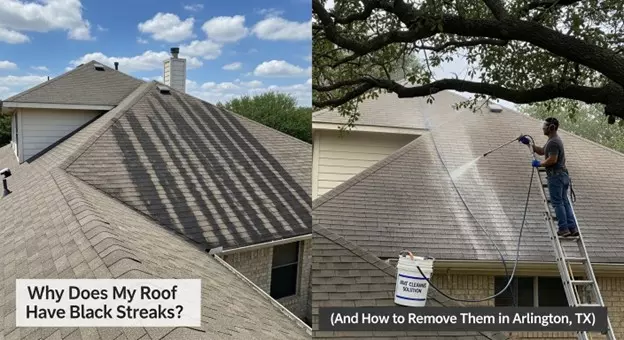
The black and dark gray streaks you see on roofs across Arlington and the DFW area are caused by a cyanobacterium (a type of algae) called Gloeocapsa Magma. It thrives in warm, humid climates — which describes North Texas for most of the year.
Gloeocapsa Magma travels through the air as tiny spores. When those spores land on a roof and find moisture, they take hold and begin to grow. They produce a dark, protective pigment — which is what you actually see as the black streaking — and they feed on the limestone filler used in asphalt shingles.
Because this algae spreads through airborne spores, it’s extremely common in neighborhoods where one or two roofs already have it. Once established, it spreads across your own roof and eventually to nearby homes.
Why Is It a Problem Beyond Appearance?
Most homeowners notice the streaks and think “that looks bad” — but the real issue goes deeper than cosmetics.
It’s actively degrading your shingles. Gloeocapsa Magma feeds on the limestone granules in asphalt shingles. Those granules are what protect your roof from UV damage and weather exposure. As the algae consumes them, the shingles become thinner and more brittle. A roof that should last 25 years can start failing at 15 to 18 years if the algae goes untreated for years.
It attracts moss and lichen. Algae is often the first wave. Once it’s established on a roof, it creates conditions that attract moss and lichen — both of which cause even more aggressive physical damage by lifting shingles as they grow.
It affects your home’s value. A streaky, discolored roof signals neglect to buyers, appraisers, and even insurance inspectors. In a competitive market like Arlington, curb appeal matters, and a dirty roof can cost you thousands in perceived value.
Why You Should NOT Pressure Wash Your Roof
This is important. When people see the streaks, the instinct is often to rent a pressure washer or hire someone with one. This is one of the most damaging things you can do to an asphalt shingle roof.
High-pressure water blasts away the granules from the surface of your shingles — the same granules the algae is eating. You’re essentially speeding up the damage instead of stopping it. A few rounds of high-pressure roof cleaning can age a roof by years in a single afternoon.
More practically: most asphalt shingle manufacturers, including GAF, Owens Corning, and CertainTeed, specifically state in their product warranties that high-pressure washing voids the warranty. If your roof has a warranty claim and it’s discovered it was pressure washed, you may be denied coverage.
The Right Solution: Soft Wash Roof Cleaning
The correct method for removing algae, moss, and biological staining from an asphalt shingle roof is called soft washing — and it’s the only method professional roof cleaners use.
Soft washing applies a low-pressure solution of water and a contractor-grade biocide to the roof surface. The solution penetrates the algae colony and kills it at the cellular level. The low-pressure rinse then washes away the dead growth.
Because the algae is killed — not just removed from the surface — soft washing results last significantly longer than any pressure-based approach. Most Arlington homeowners see clean results that last 2 to 3 years before significant new growth appears.
The process is completely safe for asphalt shingles, tile, and metal roofing. It does not remove granules, does not void warranties, and does not require anyone walking aggressively across your roof surface.
Can You DIY Roof Cleaning in Arlington?
Technically, some homeowners attempt roof cleaning themselves. But there are real reasons professionals handle this work:
Safety. Working on a wet, sloped roof is genuinely dangerous. Falls from rooftops are a leading cause of serious injury in home improvement work. The risk simply isn’t worth it for most homeowners.
Chemical handling. The biocide solutions used in professional soft washing require proper handling, dilution, and application equipment. Consumer alternatives are usually much weaker and don’t provide lasting results.
Coverage. Professional soft wash systems can apply solution evenly across an entire roof in a fraction of the time it takes manually, ensuring complete coverage with no missed areas.
For most Arlington homeowners, a professional roof soft wash every 2 to 3 years is the practical, safe, and cost-effective approach.
How Much Does Roof Cleaning Cost in Arlington, TX?
Professional soft wash roof cleaning in Arlington typically ranges from $300 to $600 depending on the size, pitch, and condition of your roof. It’s one of the better investments you can make in your home’s exterior — preventing thousands of dollars in premature shingle replacement.
Noticed black streaks on your roof?
Stegmeier Pressure Washing offers professional soft wash roof cleaning throughout Arlington, TX and the surrounding DFW area. Call or text (817) 773-8984 or request a free quote → and we’ll get your roof looking clean again.