Choose an electric pressure washer if you mainly clean cars, patio furniture, decks, and small patios. It is quieter, lighter, and needs almost no maintenance. Choose a gas pressure washer if you regularly clean large driveways, long sidewalks, or heavily stained concrete. Gas models deliver more pressure and are not tied to an outlet, but they are louder, heavier, and need oil, fuel, and engine care.
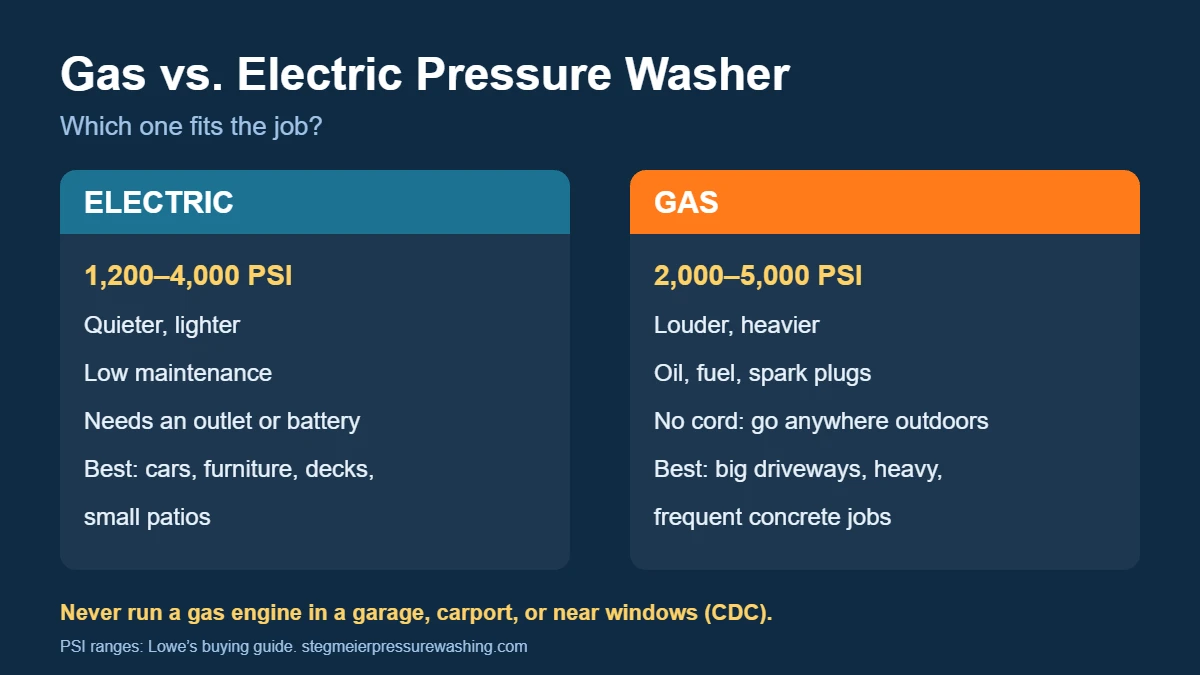
Gas vs. Electric Pressure Washer at a Glance
| Electric | Gas | |
|---|---|---|
| Pressure (PSI) | About 1,200 to 4,000 PSI | About 2,000 to 5,000 PSI |
| Power source | Wall outlet or battery | Gasoline engine |
| Noise | Quieter | Louder; hearing protection recommended |
| Weight and mobility | Lighter, but limited by the cord | Heavier, but no cord |
| Maintenance | Clean after use, occasional lubrication | Oil changes, filters, spark plugs, fuel storage |
| Upfront cost | Usually lower | Usually higher |
| Fumes | None | Exhaust with carbon monoxide; outdoors only |
| Best for | Cars, furniture, grills, decks, small patios | Large driveways, frequent concrete work, heavy stains |
When an Electric Pressure Washer Is Enough
Most homeowner jobs do not need much pressure. Cars, patio furniture, vinyl siding, and wood decks all clean in roughly the 500 to 2,000 PSI range, which is well within what an electric machine delivers. See our pressure washer PSI chart by job for the details. Electric models start with the push of a button, store easily, and can even be used in enclosed spaces, according to The Home Depot. Lowe’s notes they are usually less expensive and easier to maintain than gas.
The tradeoffs are power and range. You need an outlet within reach, and lower-powered models make large concrete jobs slow.
When a Gas Pressure Washer Makes Sense
Gas machines start around 2,000 PSI and go up to about 5,000 PSI, and heavy-duty and commercial units are commonly gas powered. That extra pressure, usually paired with higher flow, matters on a two-car driveway, a long sidewalk, or oil-stained concrete. Gas also frees you from cords, so you can clean a fence line or a back patio far from the house.
Pressure is only part of the picture. Flow (GPM) does much of the work of rinsing dirt away, which is why our PSI vs. GPM guide is worth reading before you buy.
Maintenance: What Each Type Needs
- Electric: rinse and clean the unit after use and lubricate fittings as needed. There is no engine, so there is no oil to change.
- Gas: oil changes, gas filter changes, regular lubrication, and spark plugs as needed, plus safe fuel storage. Lowe’s notes a well-maintained gas unit typically lasts longer. See our guide to what kind of oil a pressure washer uses.
Gas Pressure Washer Safety: Carbon Monoxide
Gas engines produce carbon monoxide, which you cannot see or smell. The CDC warns never to run a pressure washer engine indoors, in a garage or carport, or near open windows, doors, or vents. If you want to clean a garage floor, use an electric unit or keep the gas engine outside and well away from the house.
Buy, Rent, or Hire a Pro?
For quick jobs a few times a year, an electric washer is the practical buy. For a once-a-year driveway, renting a gas machine can make more sense than owning one. Houses and roofs are a different job: siding and shingles should be soft washed with a cleaning solution at low pressure, not blasted with a gas machine.
In Arlington and the Dallas-Fort Worth area, Stegmeier Pressure Washing’s published prices are $350 to $550 for a house wash, $150 to $300 for a driveway, and $450 to $650 for roof washing. See all of our pressure washing services, or compare pressure washing prices.
Frequently Asked Questions
Is a gas or electric pressure washer better?
Neither is better for everyone. Electric is better for light, occasional jobs because it is quieter, lighter, and easier to maintain. Gas is better for large or frequent concrete jobs because it delivers more pressure and has no cord.
What are the downsides of an electric pressure washer?
Electric models typically have less power than gas, and they need an outlet or a charged battery. That makes large driveways and stained concrete slower to clean.
Do electric pressure washers need oil?
No engine oil is needed because there is no gas engine. Maintenance is mostly cleaning the unit after use and lubricating fittings as needed. Always follow your model’s manual for pump care.
Is a gas or electric pressure washer better for a driveway?
Gas usually wins on a large or stained driveway because of its higher pressure and flow. A strong electric model can handle a small driveway with light dirt, but expect it to take longer.
Can I use a gas pressure washer in my garage?
No. The CDC warns never to run a pressure washer engine in a garage, carport, or other enclosed space because of carbon monoxide. Keep the engine outdoors and away from open windows, doors, and vents.
Sources: Lowe’s, “Electric vs. Gas Pressure Washers”; The Home Depot, “Gas vs Electric Pressure Washers”; CDC, “Warning! Carbon Monoxide Hazard”. Prices are Stegmeier Pressure Washing’s published rates as of October 2026.